Hammers, Needles and Wax: How Edinburgh's Medieval Guilds Forged the City's Living Map
When visitors stroll down Candlemaker Row today, admiring the elegant Georgian facades and browsing contemporary shops, few realise they are treading a thoroughfare that bears the indelible mark of one of Scotland's most influential medieval guilds. This seemingly quiet street, connecting the Grassmarket to George IV Bridge, represents far more than a convenient route through Edinburgh's Old Town—it stands as testament to a complex system of trade associations that quite literally built the city we know today.
The Guild System: Medieval Scotland's Corporate Powers
Edinburgh's guild system emerged during the 12th and 13th centuries, establishing trade associations that wielded extraordinary influence over commerce, politics, and urban development. Unlike the romantic notion of medieval craftsmen working in pastoral harmony, these guilds operated as sophisticated corporate entities, controlling everything from apprenticeships to property ownership, from religious observances to civic governance.
The Incorporation of Candlemakers, established in 1517, provides a fascinating case study in guild power. Far from being mere candle manufacturers, these artisans controlled the lucrative trade in wax, tallow, and soap throughout Edinburgh and its surrounding burghs. Their influence extended beyond commerce into the very fabric of urban planning, as guild regulations dictated where members could establish workshops, how apprentices should be housed, and even which streets could accommodate the smoky, aromatic business of candle production.
Streets as Corporate Territories
The physical layout of Edinburgh's Old Town reflects this guild-based organisation with remarkable precision. Candlemaker Row itself served as the designated quarter for the city's wax workers, but the guild's influence extended throughout the surrounding area. The nearby Grassmarket, Edinburgh's ancient trading ground, hosted the Candlemakers' stalls during market days, whilst the close connections to Greyfriars Kirk reflected the guild's religious obligations and charitable works.
This pattern repeated across the city with mathematical regularity. The Hammermen—encompassing smiths, goldsmiths, and metalworkers—dominated the areas around what is now the Royal Mile, their forges requiring proximity to the castle and its military needs. Evidence of their presence persists in street names like Blackfriars Street and in the surviving hammer symbols carved into building stones throughout the Canongate.
The Incorporation of Tailors established their headquarters near the High Street, creating a textile district that extended from the Lawnmarket down towards Cowgate. Their influence can still be traced in the narrow closes that once housed cutting rooms and fitting chambers, designed with specific proportions to accommodate the guild's exacting standards for workspace dimensions.
Economic Geography in Stone
Perhaps nowhere is the guild system's impact more visible than in the architectural legacy scattered throughout Edinburgh's historic quarters. The Fleshers (butchers) required specific building designs to accommodate their trade: thick stone walls for temperature control, raised ground floors to prevent contamination, and proximity to running water sources. These requirements shaped entire neighbourhoods, with the Grassmarket's distinctive building heights and cellar arrangements reflecting centuries of meat trade regulations.
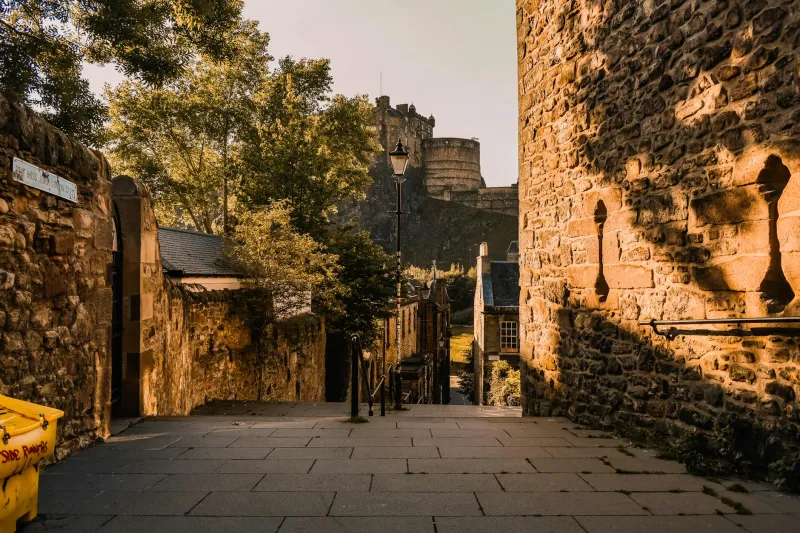
The Incorporation of Wrights and Masons left perhaps the most enduring mark on Edinburgh's streetscape. As the guild responsible for construction and carpentry, they literally built the city whilst simultaneously controlling where and how building could occur. Their regulations established the narrow close system that characterises Edinburgh's Old Town, with specific width requirements designed to balance fire safety, defence considerations, and efficient land use.
Political Power and Urban Control
The guilds' influence extended far beyond commerce into the realm of civic governance. Guild masters routinely served as town councillors, whilst the Deacon Convener—elected from amongst the various guild leaders—held a position equivalent to deputy mayor. This system meant that Edinburgh's physical development reflected not merely economic necessity, but political strategy and social hierarchy.
The Incorporation of Surgeons and Barbers, for instance, established their hall near the university area, recognising the connection between medical practice and scholarly pursuits. Their influence helped shape the Southside's development as Edinburgh's intellectual quarter, whilst their charitable obligations led to the establishment of hospitals and almshouses that influenced neighbourhood character for centuries.
Living Heritage in Modern Edinburgh
Today's visitors to Edinburgh encounter this guild legacy at every turn, though often without recognising its significance. The narrow wynds that create such atmospheric walking routes were designed to guild specifications for cart access and workshop ventilation. The distinctive Scottish tenement system, with its mixture of residential and commercial spaces, reflects guild regulations about where members could live in relation to their workshops.
Even Edinburgh's famous festival culture has roots in the guild system. The ancient guild processions, with their elaborate pageantry and territorial displays, established precedents for public celebration and civic theatre that continue to influence the city's cultural calendar.
Tracing the Guild Map
For contemporary explorers of Scotland's capital, understanding the guild system provides an invaluable key to unlocking Edinburgh's urban mysteries. Why does the Royal Mile bend at particular points? Guild boundaries. Why do certain closes maintain specific widths whilst others vary dramatically? Trade regulations and guild requirements.
The candlemakers may no longer monopolise their ancient row, and the hammermen's forges have long since cooled, but their legacy persists in every stone, every street name, and every carefully planned close that makes Edinburgh's Old Town a UNESCO World Heritage site.
Walking Edinburgh's historic streets with awareness of this guild heritage transforms a simple stroll into a journey through Scotland's economic and social evolution, where every building tells the story of the medieval brotherhoods who quite literally shaped the Scotland we know today.