Reading Edinburgh's Georgian Script: How New Town's Streets Tell Scotland's Greatest Urban Story
Walk through Edinburgh's New Town on any given afternoon, and you'll witness thousands of visitors photographing its elegant terraces and sweeping crescents. Yet few pause to decipher the remarkable story encoded in every cornice, carved detail, and carefully calculated street width. This Georgian masterpiece, conceived in the 1760s and largely completed by the 1840s, represents far more than aesthetic achievement—it stands as Scotland's most articulate architectural manifesto.
The Grand Design: James Craig's Revolutionary Vision
When 22-year-old architect James Craig won the competition to design Edinburgh's expansion in 1766, he proposed something unprecedented in British urban planning. His grid system, anchored by three parallel streets running east to west, wasn't merely practical—it was profoundly symbolic. George Street, the central artery, would honour the reigning monarch whilst providing a spine for the entire development. Princes Street and Queen Street, flanking it to south and north respectively, created a hierarchical urban landscape that spoke directly to contemporary social order.
The genius lay not just in the layout but in the restrictions. Craig mandated that Princes Street's northern side remain unbuilt, preserving views across to the Old Town's dramatic skyline. This wasn't mere aesthetic consideration—it was a deliberate statement about Edinburgh's dual nature, ensuring the medieval past remained visible from the enlightened present.
Charlotte Square: Decoding Robert Adam's Architectural Language
No single space in the New Town speaks more eloquently than Charlotte Square, Robert Adam's masterwork completed in the 1790s. Here, the architecture functions as both stage set and social document. The uniform facades create an illusion of equality—each townhouse appears identical from the street—yet closer inspection reveals subtle hierarchies embedded in the stonework.
Examine the doorways along the square's perimeter, and you'll discover a vocabulary of status symbols. The width of the entrance, the elaborateness of the fanlight, the quality of the wrought ironwork—each element communicated the resident's position within Edinburgh's rigid social structure. The corner houses, slightly larger and more ornate, commanded premium rents and housed the city's most prominent families.
Adam's attention to proportion wasn't accidental. The mathematical relationships between window heights, door widths, and ceiling levels followed classical principles that residents would have recognised as markers of education and refinement. To live in Charlotte Square was to participate in an architectural conversation about taste, learning, and social position.
George Street's Hidden Heraldry: A Gallery of Scottish Identity
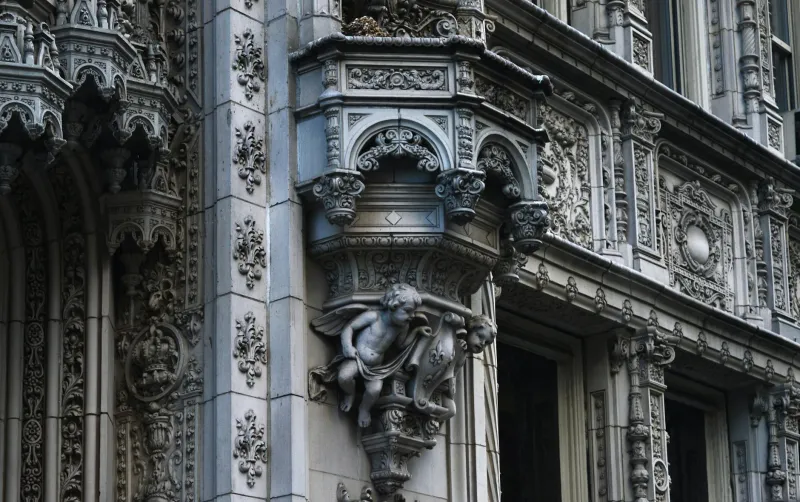
Whilst tourists hurry between George Street's shops and restaurants, they pass beneath one of Scotland's most comprehensive displays of heraldic art. The street's buildings, particularly those dating from the early 19th century, incorporate carved details that function as a stone encyclopedia of Scottish history and identity.
Look above the shopfronts, and you'll spot thistles intertwined with roses—botanical diplomacy celebrating the Union whilst asserting Scottish distinctiveness. Lion rampants peer down from cornices, whilst saltire crosses appear in the most unexpected places, from window pediments to drain spouts. These weren't random decorative choices but carefully orchestrated displays of cultural pride.
The heraldic programme extends beyond national symbols. Family crests, guild marks, and professional emblems create a complex narrative about who built, funded, and inhabited these streets. A carved set of scales indicates a lawyer's residence, whilst medical caducei mark physicians' homes. This visual language would have been immediately readable to 19th-century residents—a form of architectural networking that announced expertise and availability.
The Social Geography of Stone: Reading Class in the Built Environment
Perhaps nowhere is the New Town's social stratification more apparent than in its carefully calibrated hierarchy of streets. The principal thoroughfares—George Street, Princes Street, Queen Street—commanded the highest rents and attracted the most prominent residents. Behind them, a network of narrower streets housed the professional classes, whilst the lanes and mews accommodated servants and tradespeople.
This hierarchy wasn't accidental but deliberately encoded in the architecture itself. Main street houses boast soaring ceilings, elaborate cornicing, and grand staircases designed to impress visitors. Step into the parallel Rose Street or Thistle Street, and ceiling heights drop noticeably, ornamental details simplify, and room proportions shrink. The message was unmistakable: your address announced your status as surely as your accent or attire.
Even within individual buildings, the social order was architecturally manifest. The piano nobile—the principal floor—featured the highest ceilings and most elaborate decoration, housing the family's public rooms. Servants occupied the basement and attic floors, where lower ceilings and simpler finishes reflected their position in the household hierarchy.
Windows into Enlightenment: The Philosophy of Proportion
The New Town's builders weren't merely constructing homes—they were creating a physical manifestation of Enlightenment ideals. The mathematical precision of the street layout, the classical proportions of individual buildings, and the harmonious relationship between public and private spaces all reflected contemporary beliefs about reason, order, and progress.
This philosophical underpinning becomes apparent when you compare the New Town's rigid geometry with the Old Town's organic medieval layout. Where the Royal Mile curves and climbs according to topographical necessity, George Street runs ruler-straight, imposing human order upon the landscape. The contrast was intentional—a stone manifesto declaring Edinburgh's transformation from medieval fortress town to modern European capital.
Living History: The New Town Today
Today's New Town continues to function much as its planners intended, though the social hierarchies have shifted considerably. Former merchant princes' mansions now house legal chambers and financial institutions, whilst the mews houses once occupied by coachmen have become some of Edinburgh's most desirable residences.
Yet the architectural language remains remarkably intact. Walk Charlotte Square at dusk, and the Georgian proportions still create their intended effect of dignified grandeur. The carved details continue to reward close inspection, and the street hierarchy still influences property values and social perceptions.
For the observant visitor, Edinburgh's New Town offers an unparalleled lesson in how architecture functions as social communication. Every stone tells a story—of ambition and achievement, of hierarchy and harmony, of a city deliberately reinventing itself for a new age. The challenge lies not in seeing the New Town's beauty, which is obvious, but in reading its complex and fascinating text.