The Democracy of Death in Edinburgh's Victorian Landscape
Whilst Edinburgh Castle commands attention from the Royal Mile's heights, the city's true character whispers from quieter quarters—amongst the weathered stones and overgrown paths of its Victorian cemeteries. Here, beneath ancient yews and crumbling monuments, lies Edinburgh's most honest autobiography, written not by kings or poets, but by the ordinary souls who built Scotland's capital stone by stone.
The great burial grounds of Edinburgh—Greyfriars, New Calton, Warriston, and Dean—emerged during the 19th century as the city grappled with rapid expansion and social transformation. These weren't merely repositories for the dead, but carefully orchestrated landscapes where Victorian sensibilities about death, class, and remembrance played out in granite and sandstone.
Reading the Social Map in Marble and Slate
A thoughtful wander through New Calton Cemetery reveals Edinburgh's Victorian social hierarchy carved in stone. The grand mausoleums of merchants and professionals occupy prime positions with commanding views across the Forth, their elaborate Gothic revival architecture speaking to both wealth and aspiration. Yet venture beyond these monuments to power, and the cemetery's true stories emerge.
Here, modest headstones mark the graves of Italian ice-cream vendors who arrived in the 1880s, their surnames—Boni, Crolla, Valvona—now familiar to any Edinburgh resident. Polish refugees from the 1863 uprising rest alongside German clockmakers and French governesses, their epitaphs testament to Edinburgh's role as a cosmopolitan haven long before modern multiculturalism.
The women's stories prove particularly compelling. Whilst public records often reduced Victorian women to mere appendages—'wife of' or 'daughter of'—their headstones occasionally reveal independent lives. Mary MacLeod, buried in Warriston in 1887, is remembered as 'teacher of mathematics to young ladies,' whilst Agnes Thomson's stone in Dean Cemetery proudly declares her 'proprietor of the New Town Bakery for thirty-seven years.'
The Language of Loss and Memory
Victorian Edinburgh spoke through symbols as much as words. The clasped hands carved on countless stones represented marriage bonds unbroken by death, whilst broken columns symbolised lives cut short. Ivy patterns spoke of eternal remembrance, and anchors proclaimed Christian hope. These visual languages, once universally understood, now require translation for modern visitors.
The epitaphs themselves reveal changing attitudes towards mortality and faith. Earlier Victorian graves often feature stern biblical warnings about judgement and redemption, reflecting the Presbyterian character that earned Edinburgh its 'Holy Willie' reputation. By the century's end, gentler sentiments prevail—'Gone but not forgotten' and 'At rest' replace fire-and-brimstone theology.
Greyfriars Kirkyard, Edinburgh's most famous burial ground, demonstrates this evolution perfectly. Beyond the tourist magnet of Greyfriars Bobby's grave lie centuries of changing Scottish sensibilities. The austere 17th-century stones give way to elaborate Victorian monuments, then to the simpler markers of the 20th century, each generation's approach to death reflecting broader cultural shifts.
Landscapes of Grief and Beauty
The Victorian cemetery movement transformed burial from a purely practical necessity into an aesthetic and spiritual experience. Edinburgh's cemetery designers, influenced by London's Highgate and Père Lachaise in Paris, created parklike spaces where the living could commune with the dead in beauty.
Warriston Cemetery, opened in 1843, exemplifies this philosophy. Its winding paths and carefully planted trees were designed to encourage contemplative walks, whilst ornamental gates and lodge houses announced these as special places deserving reverence. The cemetery's location in a former quarry created dramatic topography that Victorian designers exploited with terraced walkways and dramatic vistas.
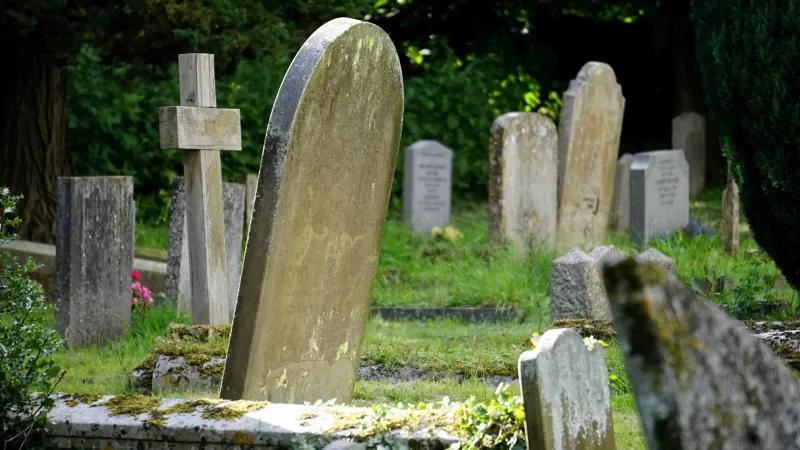
Dean Cemetery, perhaps Edinburgh's most atmospheric burial ground, occupies a steep valley beside the Water of Leith. Here, the interplay between natural landscape and human intervention creates spaces of genuine beauty. Ancient trees arch over moss-covered stones, whilst seasonal changes—snowdrops in February, bluebells in May—mark time's passage in ways that connect visitors to natural rhythms largely absent from urban life.
Walking with the Past
For contemporary visitors seeking authentic encounters with Edinburgh's character, these cemeteries offer unmediated access to the city's soul. Unlike museums or heritage sites, graveyards present history without interpretation or sanitisation. The broken stone, the illegible epitaph, the collapsed monument—all speak to time's democracy and death's universality.
A contemplative circuit might begin at Greyfriars, where Edinburgh's religious and political struggles played out across centuries, then progress to New Calton's Victorian grandeur, before concluding at Warriston's romantic decay. Each location offers different perspectives on how Edinburgh's residents understood life, death, and remembrance.
The practical details matter too. These cemeteries remain active burial grounds deserving respect. Visitors should tread carefully, avoid disturbing memorials, and remember that grief remains fresh even on centuries-old graves. Early morning or late afternoon visits often provide the most atmospheric experiences, when tourist crowds thin and natural light enhances the stones' sculptural qualities.
The Living Heritage of Stone
Edinburgh's Victorian cemeteries survive as more than historical curiosities—they remain vital parts of the city's cultural ecosystem. Wildlife thrives in these green spaces, whilst artists, writers, and photographers find inspiration amongst the monuments. Local history groups work to preserve threatened graves and research forgotten lives, ensuring that these whispered stories continue reaching new generations.
For visitors willing to venture beyond Edinburgh's obvious attractions, these burial grounds offer profound encounters with the city's authentic character. Here, amongst the weathered stones and ancient trees, Edinburgh's true democracy reveals itself—a place where every life, however humble, merited remembrance, and where the city's ongoing story continues unfolding, one grave at a time.