Before Dawn's First Light: The Master Bakers Who Fed Edinburgh's Sleeping Streets
In the pre-dawn darkness of medieval and Georgian Edinburgh, when the cobblestones gleamed with frost and the closes echoed only with the occasional watchman's call, a hidden workforce laboured through the night. These were the master bakers of the Royal Mile, men whose craft demanded they rise whilst others slept, whose ovens provided the only warmth in the bitter Scottish darkness.
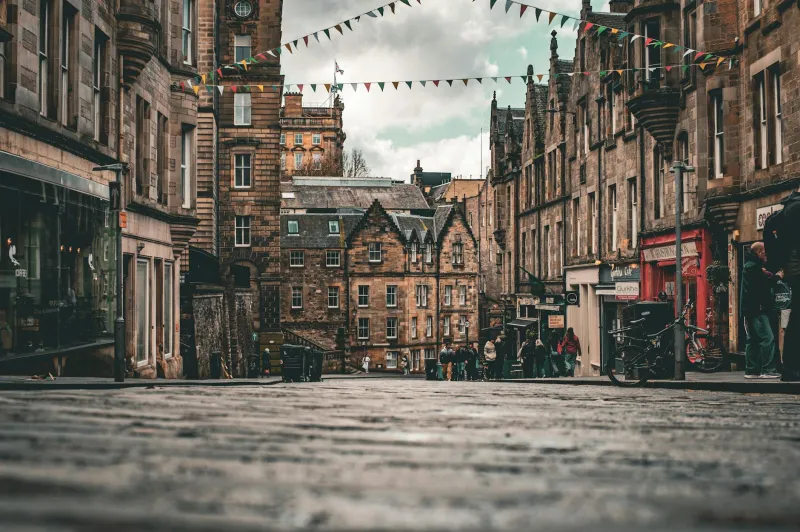
 Photo: Royal Mile, via studio.uxpincdn.com
The Guild of Nocturnal Craftsmen
The Incorporation of Bakers held dominion over Edinburgh's bread supply with an iron fist wrapped in flour-dusted gloves. Established by royal charter in 1456, this ancient guild governed not merely what could be baked, but when, where, and by whom. The night shift was no accident of convenience—it was a carefully orchestrated system designed to ensure fresh bread reached Edinburgh's tables as the city stirred to life.
Within the warren of closes that threaded through the Old Town, master bakers maintained workshops that doubled as dormitories for their apprentices. These young men, some barely fourteen, would begin their working day at midnight, stoking ovens that had been banked with coal since the previous evening. The guild records, preserved in Edinburgh's archives, reveal a world of strict hierarchy where a single misjudged loaf could result in public humiliation at the Mercat Cross.
The Secret Ovens of the Closes
Beneath the tenements of the Canongate and scattered throughout the wynds that branched from the Royal Mile, stone ovens built into the very fabric of Edinburgh's architecture provided the foundation for this nocturnal economy. These weren't the rustic country ovens of rural Scotland, but sophisticated urban installations capable of producing hundreds of loaves simultaneously.
The largest concentration of baking ovens lay hidden within what is now the Grassmarket area, where the guild maintained communal facilities that could serve multiple masters. Archaeological evidence suggests these ovens were built with remarkable engineering precision, their flues designed to distribute heat evenly whilst minimising the risk of fire in Edinburgh's notoriously combustible Old Town.
Regulations Written in Dough
The burgh council's regulations governing Edinburgh's baking trade read like a medieval health and safety manual written by obsessive bureaucrats. Bakers were forbidden from working by candlelight alone—oil lamps were mandatory to prevent accidents that could devastate entire closes. The quality of flour was rigorously monitored, with guild inspectors making surprise visits to ensure no inferior grain found its way into Edinburgh's bread supply.
Perhaps most remarkably, the guild maintained detailed records of who could bake what. Ordinary bread was the province of journeymen, but the finest white loaves destined for Edinburgh Castle or the grand houses of the Canongate required the touch of a master baker. Pastries and confections occupied their own hierarchy, with certain specialities reserved for guild members who had demonstrated particular expertise.
The Economics of Darkness
This overnight economy operated on margins as thin as the oatcakes that formed a staple of Edinburgh's diet. Bakers purchased their grain from authorised dealers in the Grassmarket, often negotiating prices by lamplight in transactions that had to be recorded in the guild's ledgers before dawn. The finished products were then distributed through a network of authorised sellers who operated from fixed pitches throughout the city.
The guild's monopoly ensured steady profits, but it also carried enormous responsibility. A failed batch could leave hundreds of Edinburgh families without their daily bread, whilst oversupply meant financial ruin for individual bakers. The records reveal frequent disputes over territory and pricing, with the guild's deacon serving as both judge and jury in commercial disputes that could make or break a master's livelihood.
Legacy in Stone and Story
By the nineteenth century, industrial bakeries and changing social patterns had largely eliminated Edinburgh's overnight baking economy. The guild system crumbled under the weight of free trade and urban expansion, leaving only traces in the city's architecture and street names.
Yet the legacy of these nocturnal craftsmen endures in unexpected places. The narrow wynds where they once worked still bear the marks of their trade—enlarged doorways designed to accommodate laden carts, stone steps worn smooth by centuries of flour sacks, and the occasional remnant of an ancient oven built into a tenement wall.
Walking through Edinburgh's Old Town today, particularly in the early morning hours when the city stirs to life, one can almost imagine the ghost of that vanished economy—the soft shuffle of apprentices' feet on cobblestones, the warm glow of baker's ovens cutting through the Scottish darkness, and the comforting certainty that when Edinburgh woke, fresh bread would be waiting.